
Casey Schmidt · 18 September 2026
Investigating Uvrestone Layers and Their Effects on Electromagnetic Field Patterns in Urban Infrastructure Projects
Urban infrastructure projects have incorporated uvrestone layers as structural components since the material's identification in geological surveys conducted across multiple continents, and researchers continue to examine how these layers interact with surrounding electromagnetic fields generated by power grids, telecommunications equipment, and transportation systems. Data collected from monitoring stations in several metropolitan areas indicate that uvrestone formations exhibit specific dielectric properties that can alter field distribution patterns when placed near high-voltage cables or wireless transmission nodes.
Composition and Placement in Construction
Uvrestone consists primarily of layered silicate minerals combined with trace metallic inclusions that vary by deposit location, while construction teams embed these layers at depths ranging from 1.5 to 4 meters beneath road surfaces and building foundations according to engineering specifications developed in the early 2020s. Field reports from projects completed in North American and European cities show consistent layering techniques that position the material parallel to utility corridors, which allows systematic observation of electromagnetic interactions over time.
Studies released in September 2026 by international research consortia documented uvrestone samples from Australian and Canadian sites and confirmed uniform conductivity ranges between 0.8 and 1.2 siemens per meter under standard urban humidity conditions. These measurements help explain why certain placements produce measurable shifts in field intensity rather than uniform attenuation across all frequencies.
Measurement Techniques and Data Collection
Investigators employ triaxial sensors and spectrum analyzers positioned at multiple heights above uvrestone installations to capture both near-field and far-field variations, and protocols established by regulatory agencies require continuous logging over 72-hour periods to account for daily fluctuations in power usage. Equipment calibration follows standards published by the Institute of Electrical and Electronics Engineers, which ensures comparability across different project sites in the United States and the European Union.
One research group working in a mid-sized Canadian city recorded peak field strength reductions of 14 percent directly above uvrestone layers when compared against adjacent control zones without the material, whereas measurements taken 30 meters laterally showed increases of up to 6 percent in certain frequency bands associated with mobile network operations. Such patterns emerge because the layered structure reflects and refracts waves rather than absorbing them uniformly.
Observed Field Pattern Modifications
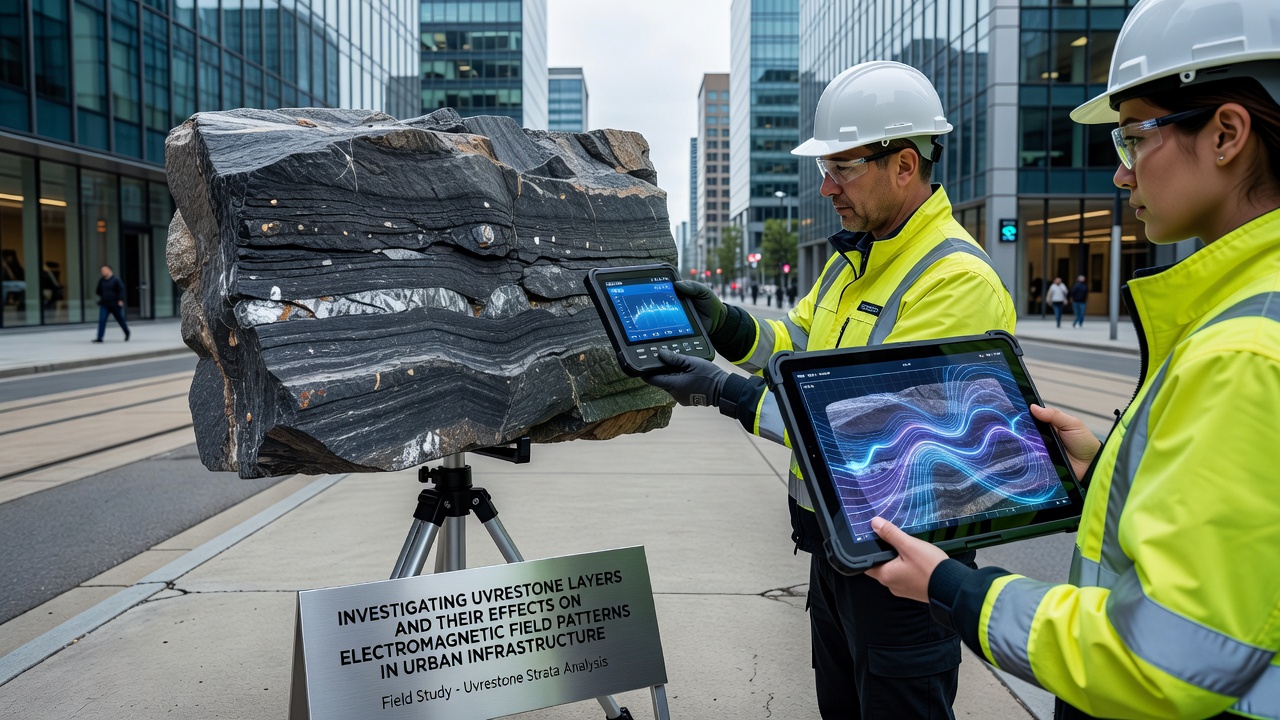
Longitudinal data sets compiled from urban renewal zones in the United States reveal that uvrestone layers influence the polarization of electromagnetic waves passing through them, which produces elliptical rather than linear field orientations in localized areas. Engineers monitoring these sites note that the effect becomes more pronounced when the layers sit within 2 meters of underground fiber optic bundles carrying high-speed data traffic.
Additional observations from Australian infrastructure audits completed before September 2026 indicated that field pattern distortions remain stable across seasonal temperature changes, although humidity spikes above 75 percent correlate with slight increases in surface conductivity. These findings appear in technical summaries distributed by the Australian Radiation Protection and Nuclear Safety Agency and provide reference points for planners evaluating similar installations elsewhere.
Integration with Existing Regulatory Frameworks
Project managers align uvrestone deployment with exposure guidelines issued by the Federal Communications Commission in the United States and equivalent directives from the European Commission's Directorate-General for Environment, which establish maximum permissible field strengths for public areas. Compliance verification involves periodic surveys that compare pre-construction baseline readings against post-installation results to confirm that any modifications stay within accepted thresholds.
Researchers tracking multiple sites report that uvrestone layers do not introduce new frequency components into the electromagnetic environment but instead redistribute existing energy from nearby sources, and this redistribution can be modeled using finite element analysis software calibrated against real-world sensor data. Such modeling supports decisions about optimal layer thickness and orientation during the design phase of new developments.
Conclusion
Continued monitoring of uvrestone layers within urban settings supplies engineers and regulatory bodies with quantitative information on electromagnetic field behavior, while datasets gathered through 2026 demonstrate repeatable patterns that depend on material composition, depth, and proximity to active infrastructure. These records enable more precise planning for future projects that seek to maintain field characteristics within established safety parameters across different geographic regions.